Know the bias
before the market opens.
Your cockpit for the trading day. The Engine scans positioning, liquidity, seasonality and headlines, then hands you a directional bias on NQ, ES and GC — before you even sit down.
SCAN. BIAS. EXECUTE. LOG.
Signups closed · existing pilots only
Signups closed · these are the plans that open when new seats return
Why most
traders fly blind
You open the charts at 9:25, scroll Twitter for "sentiment", and pick a direction based on the last candle you saw.
Meanwhile the session's direction was already being set by positioning, liquidity and seasonality. Data you never looked at, because pulling it takes two hours you don't have.
The Engine pulls it in fifteen seconds and hands you the bias before the bell. That's the whole point.
The Scan
One click before the session. The Engine sweeps positioning, liquidity, seasonality and headlines while you pour your coffee.
The Bias
Long, short or stand down. Per ticker, with a score, a confidence level and the exact drivers behind the read.
The Execution
You trade your model in the direction the macro already agrees with. The Engine logs the call and keeps its own score.
The same morning, twice.
Nothing about your model changes. What changes is how much you know before you use it.
illustrative reading · not a performance claim
Watch it think.
A looped simulation of the daily scan. The real cockpit output looks exactly like this, with live data behind every line.
- ▸Fed net liquidity expanding for a third straight week
- ▸Seasonality tailwind: 15y average for this month is positive
- ▸Breadth confirming: index heavyweights leading the push
- ▸COT: hedge funds adding longs into strength
- ▸COT positioning crowded on the long side
- ▸Dollar bid and real yields firming into the session
simulated output · your cockpit runs this on live data every morning
Inside the cockpit
No mockups. This is the real thing, running on live data. One screen before the session: the scan, the reasons, the instruments.
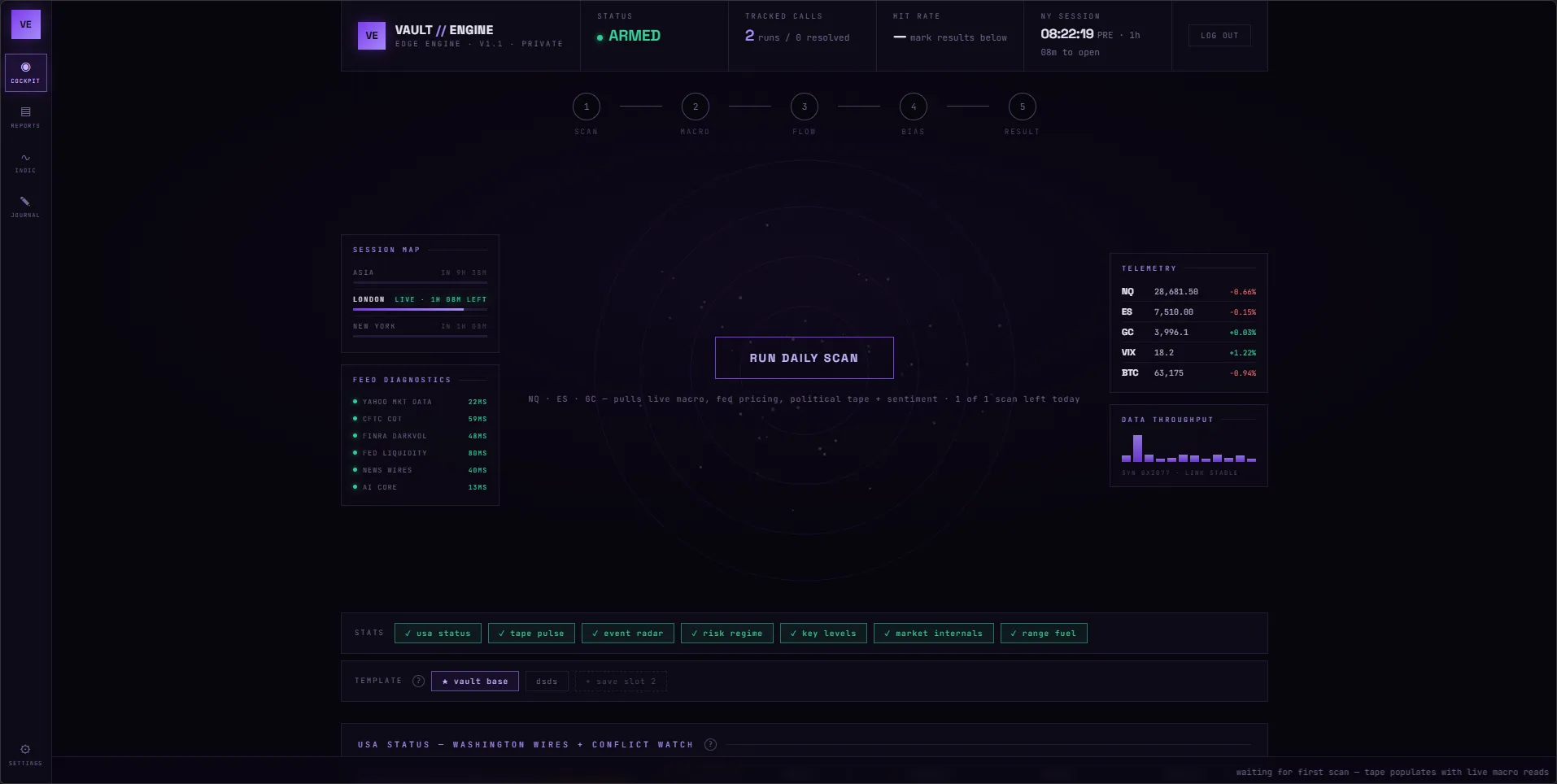
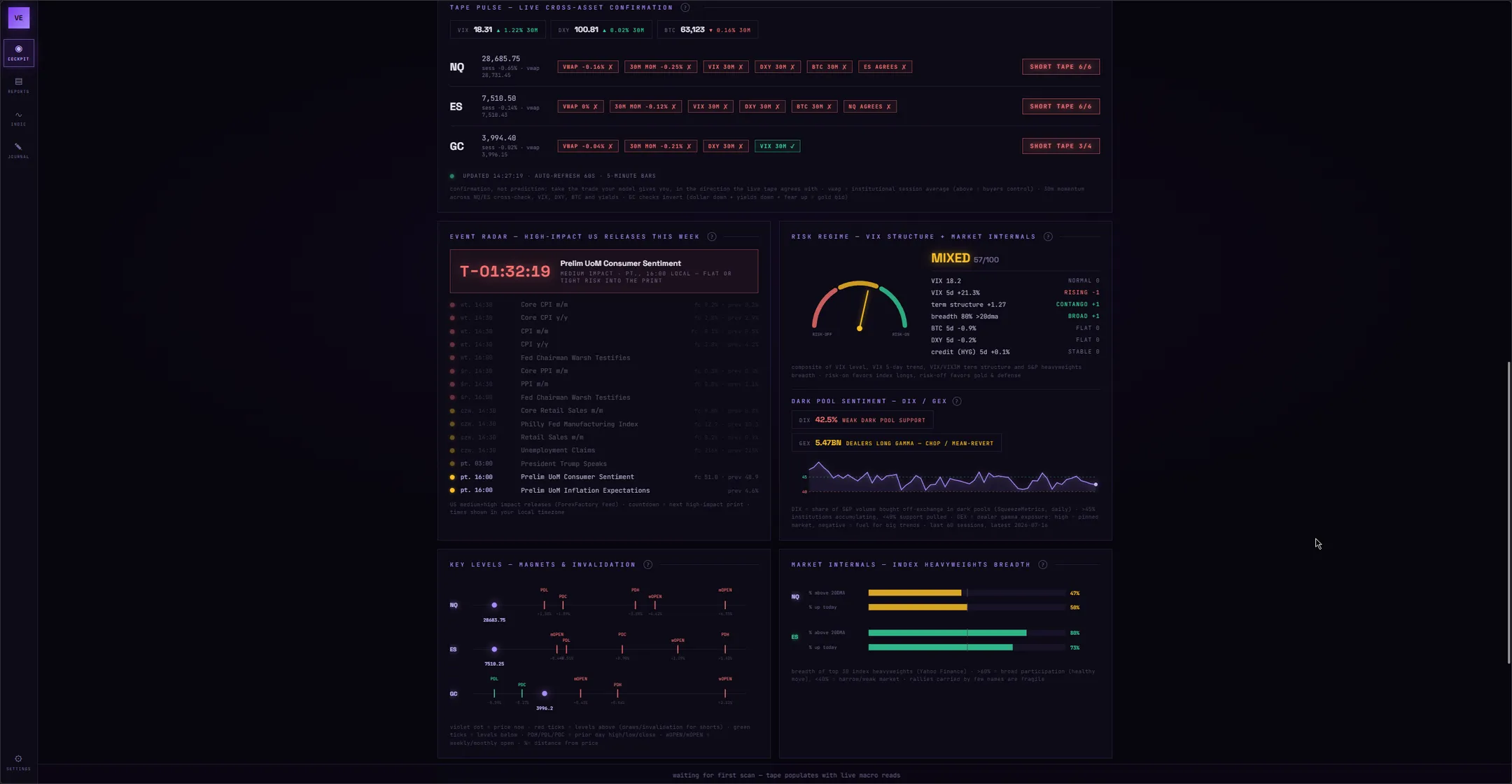
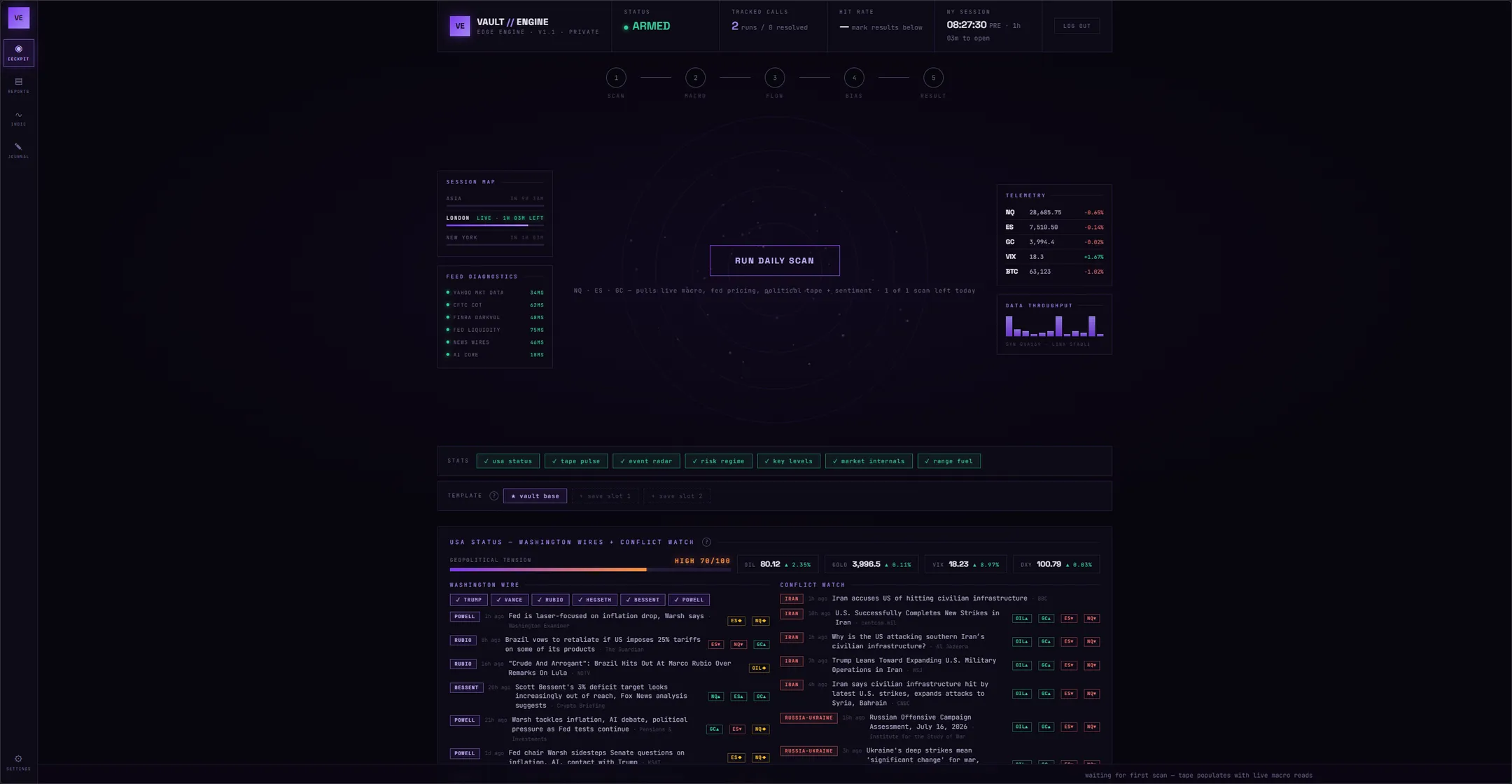
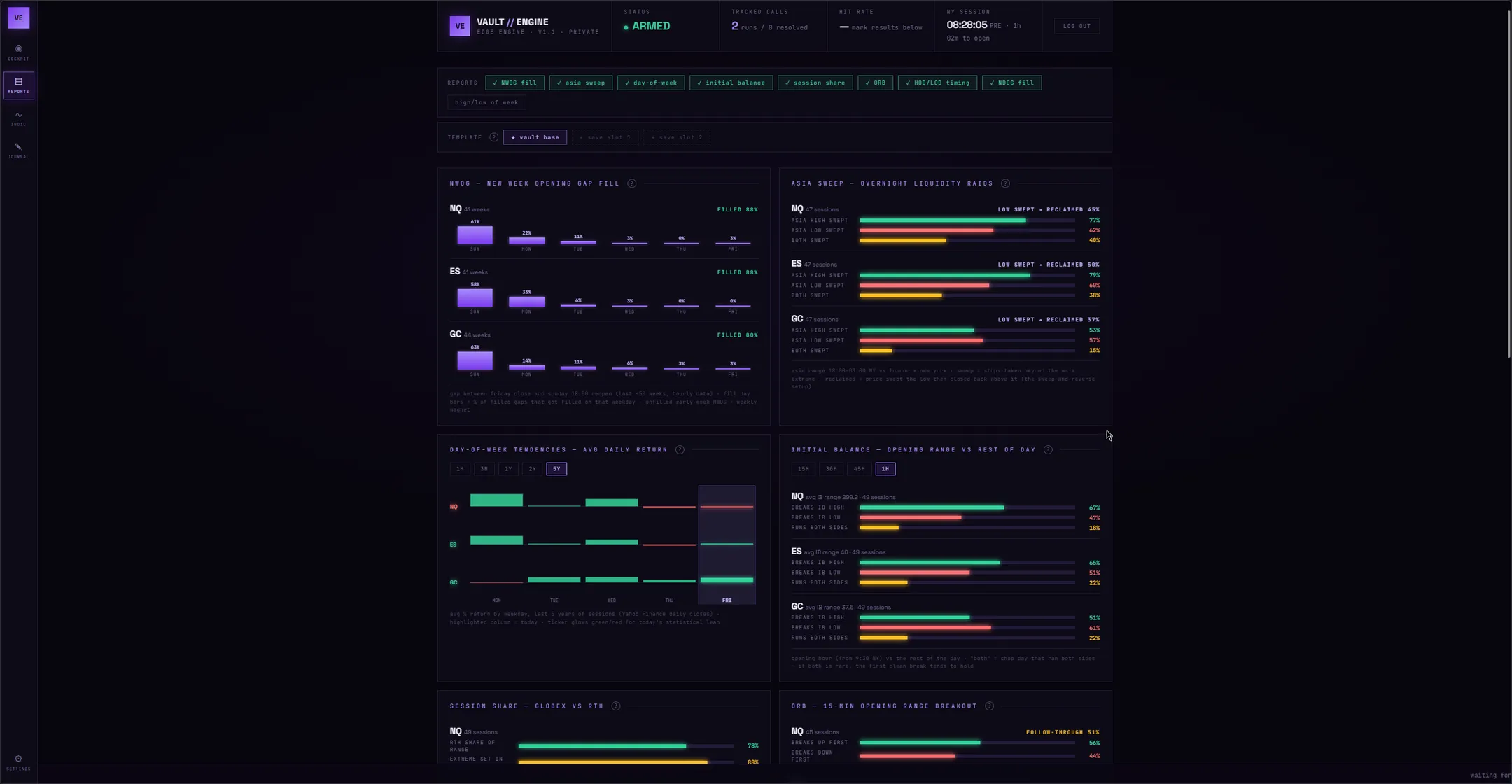
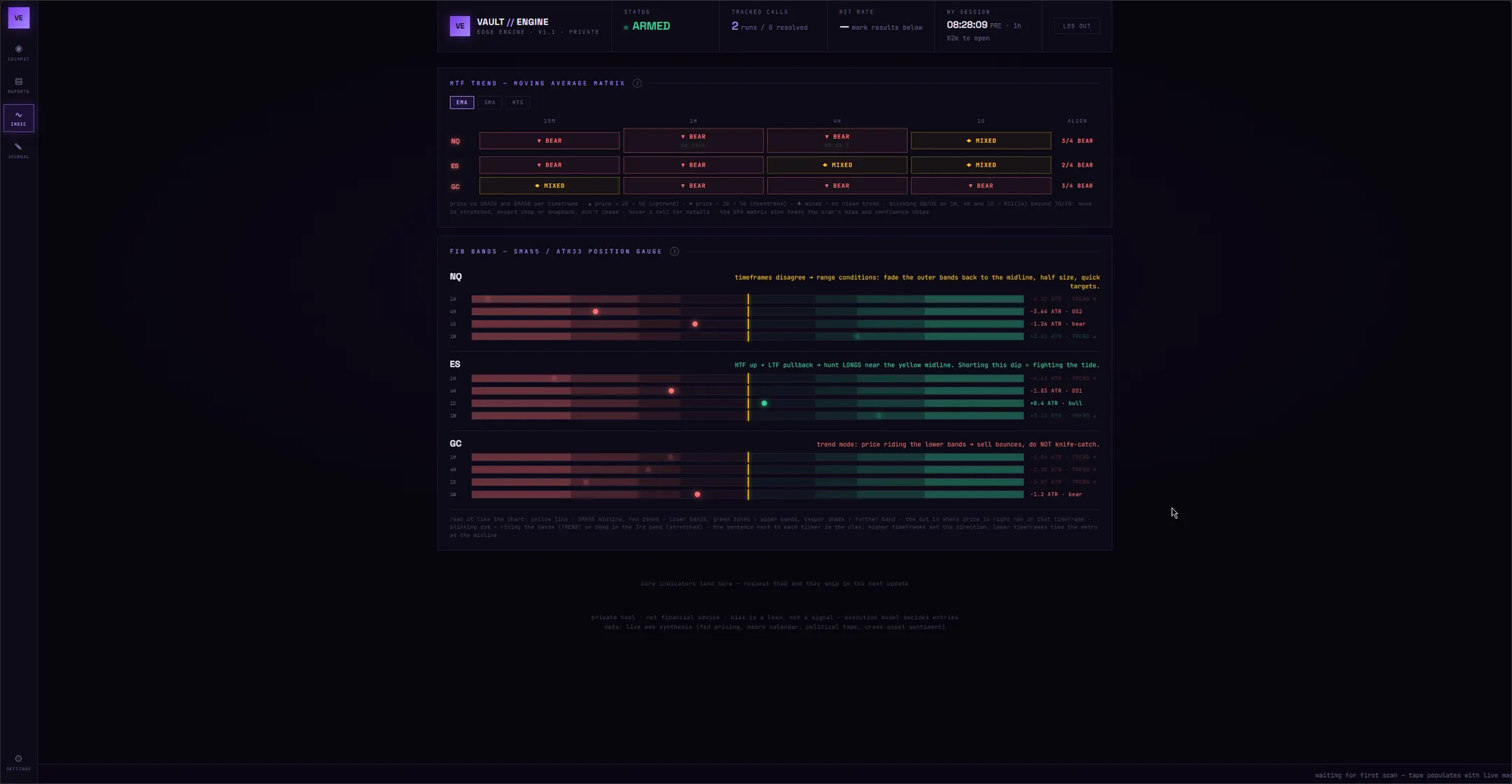
the cockpit before the bell: one button, three markets, live feed diagnostics
Choose your cockpit
New seats are closed while we work on the Engine. These are the plans that open when they come back.
Recon
Pilot
Command
Signups are closed. Existing members keep full access to their plan.
Every instrument on deck
12 instruments. 1 scan. 15 seconds.
Session Bias Cards
Long / short / neutral on NQ, ES and GC, with score, confidence and the exact drivers in plain english.
Tape Pulse
Live cross-asset confirmation. Each green tick means the market agrees with the bias right now.
Risk Regime
VIX structure and market internals. Is big money brave or scared today?
Key Levels + Range Fuel
Price magnets, invalidation, and how much of today's ATR14 tank is already burned.
Event Radar
High-impact US releases this week: CPI, Fed, jobs, with a countdown to the next one.
USA Status
Washington wires and the conflict watch. What the people who move markets just said.
Seasonality + Day-Of-Week
Average monthly and weekday returns, plus which day sets the high / low of the week.
COT Positioning
Hedge funds vs retail. See who is crowded before you fade them.
Fed Liquidity + Rate Path
SOMA − TGA − RRP, and what fed funds futures are actually pricing in.
Session Mechanics
HOD/LOD timing, initial balance, ORB, asia sweep, NWOG / NDOG gap fills, globex vs RTH.
MTF Trend + Fib Bands
Moving-average matrix across every timeframe, and your SMA55 / ATR33 position gauge.
Journal + Vault Score
Log a trade in ten seconds, then work it: tape, edge, playbook, debrief. Win %, avg win/loss and profit factor collapse into one honest number, synced to your account.
The Engine keeps score.
Every call gets logged the moment it runs. Every call gets marked hit or miss. The hit rate sits in your cockpit where you can audit it yourself. No deleted calls, no cherry-picking.
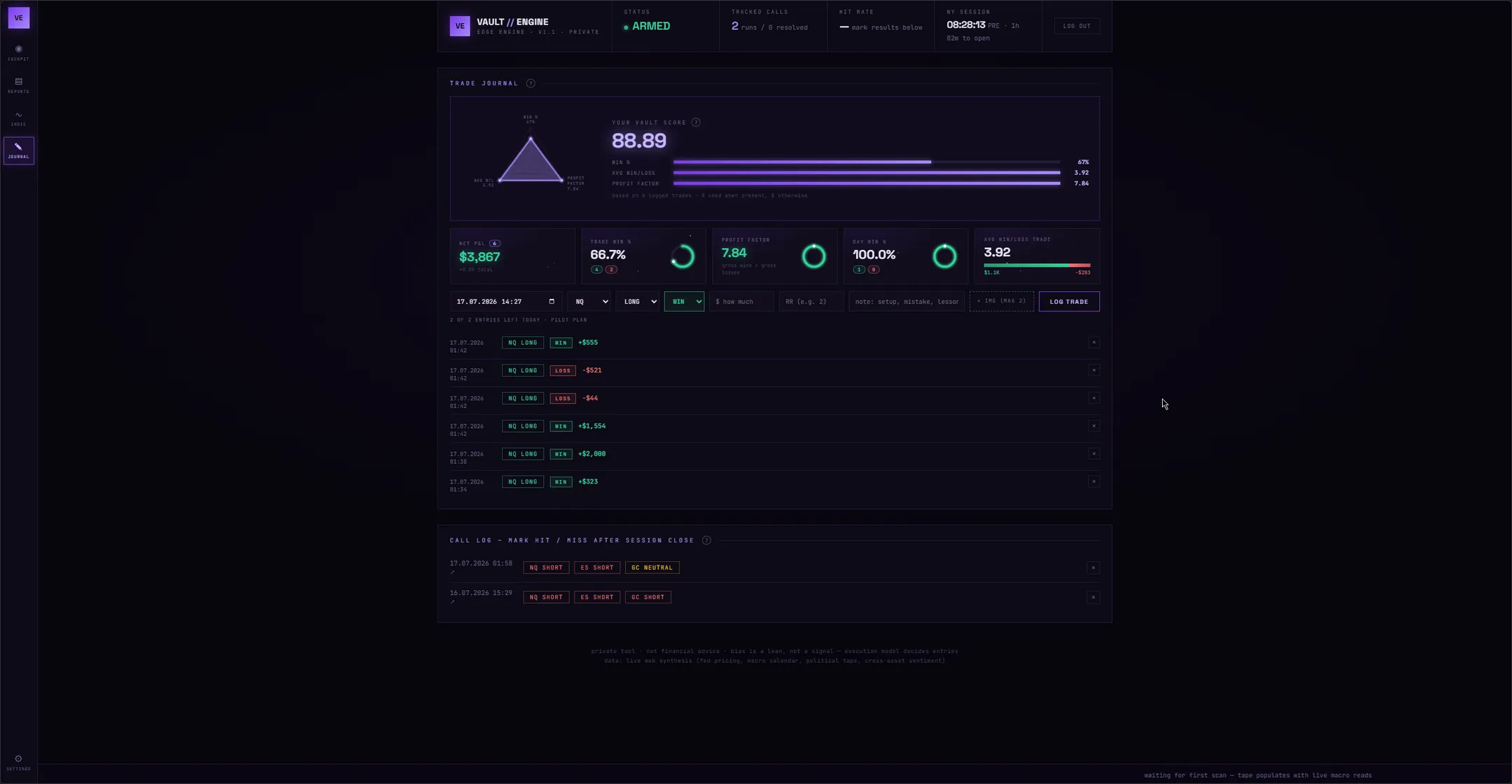
the journal and call log as they ship · figures shown are example data, not a performance claim
Why this isn't
another signal group
Built for anyone who has to pick a side.
You bring the model and the risk. The Engine settles the one question every session starts with: which direction is the macro already leaning?
Evaluation rules leave no room to guess.
Daily loss caps and drawdown limits punish the sessions you enter with no read at all. See where positioning, liquidity and seasonality sit before you place the first trade of the day.
Stop picking a direction at 9:25.
The session bias is set long before the open by positioning, liquidity and seasonality. Sit down already knowing it instead of reading it off the first candle.
Hold with the backdrop, not against it.
The hardest part of a multi-day hold is knowing whether the macro is still behind you. Check the same instruments every morning and find out in fifteen seconds.
Get the read before work, not after.
Two hours of macro prep is not happening on a weekday. One scan with your coffee is. The bias holds on screen all day, so you can check it on your break.
Keep the discretion, lose the coin flip.
Nobody is asking you to trade someone else's signals. The Engine only settles the direction question, so your judgement is spent on entries instead of guessing bias.
Start again on a scoreboard you can audit.
Every call is logged the moment it runs and marked hit or miss after the close. No deleted trades, no rewritten history — just a record you can actually learn from.
Pre-flight checks.
Everything you need to know before you power up the Engine.
No, and the difference matters more than it sounds. A signal service hands you an entry, a stop and a target, and asks you to trust a stranger's judgement on all three. You learn nothing, you can't audit anything, and the day the calls stop working you have no idea why. The Engine never tells you what to click. It answers one question — which direction the macro landscape currently favours on NQ, ES and GC — and then shows its work: the drivers behind the read, a confidence level, and the condition that would flip it. Everything downstream of that stays yours. Your entry model, your risk, your timeframe, your decision to sit the day out. What changes is that you make those calls knowing whether positioning, liquidity and seasonality are behind you or against you, instead of finding out at 11am. Think of it as the difference between someone shouting a trade at you and someone handing you the weather report before you fly.
One click. The Engine sweeps positioning (COT), fed liquidity, the rate path, seasonality, breadth, correlations, short volume and the morning headlines, then synthesizes it into a per-ticker session bias with a score and confidence. The whole cycle takes about 15 seconds, and the read stays on screen until you run the next one — reload the tab, come back after lunch, today's bias is still there.
Three: NQ, ES and GC. The markets prop traders actually live in. The Engine goes deep on those instead of spreading itself thin across forty tickers it reads badly. The instrument panels cover the macro backdrop driving all three.
The journal workspace, capped at one entry per day, plus your core stats: total R, win rate and average. That is the whole free plan and it stays free. The daily scan, the reports, the indicators and the Vault Score sit behind Pilot.
On your account, not in your browser. Trades, playbook, debriefs, payout certificates and expenses are stored server-side and pulled down the moment you log in, so the desk follows you from laptop to phone. Clear your cache, switch machines, nothing is lost.
Every scan pulls live data from a stack of upstream feeds, so it has a real cost per run. Pilot gives you one scan a day, which is what a one-session trader needs. Command gives you three, for traders who reload when the tape turns. Journal entries are capped the same way: 1 a day free, 2 on Pilot, 5 on Command. Limits reset every day at midnight.
It will be wrong sometimes, and the Engine is built so you can see exactly how often. A bias is a lean, not a prophecy: it says the weight of the evidence sits on one side today, and the confidence score tells you how heavily. That is why every read ships with a flip level — the condition that invalidates it — so being wrong is a thing you notice early instead of something you discover in your drawdown. The calls are logged automatically the moment they run and marked hit or miss after the close, and the running hit rate sits in your own cockpit where you can audit it. Nothing is deleted or quietly edited. If the Engine goes cold, you will be the first to know, because the scoreboard is yours and it is always on.
Because they post what is interesting, not what is relevant, and never on your schedule. A good macro account might cover COT positioning this week and skip it for a month, or post the liquidity chart after the move has already happened. You end up with a scattered feed you have to assemble yourself, from people who are not accountable to a record. The Engine reads the same categories in the same order every single morning, before the open, and it reads all of them whether or not this week's take is exciting. Consistency is the entire product: the value is not that any one input is secret, it is that you never sit down without having checked all of them.
Yes. It is a subscription with no lock-in, monthly or annual. Cancel in one click and you keep access until the end of the period you paid for. The free journal stays available either way.
Every scan is logged automatically the moment it runs. No deleting, no editing. After the close you mark each call hit or miss, and the Engine computes its own running hit rate right in your cockpit. The scoreboard is always on.
They were built for each other. The Vault gives you the entry model: where and how to engage. The Engine gives you the daily directional bias: which side to engage from. Bias plus model is the full stack.
On the sign-up form. A beta invite code is one-time and opens a full cockpit seat for two weeks, after which the account settles onto Recon unless you upgrade. An affiliate code is optional and just credits whoever sent you. Neither one is required to open a normal account.
No. You log in, you press scan, you read the bias. Everything runs in the cockpit, and every view has its own link, so you can bookmark the panel you check first and land straight on it. No installs, no configs, no spreadsheets.
The scan runs at dawn either way.
The only question is whether you read it before the bell or spend the first hour of the session working out what the data already said.
Signups closed · existing pilots only